Suitability Criteria#
NOTE: If you are not familiar with the different suitability functions and how to use them, we recommand you start with the Suitability Functions tutorial, which provides an overview of the available functions and their usage.
SuitabilityCriteria is used to defined a criteria, set its associated indicator, and described how its suitability is computed. It has the following attributes:
name: criteria name
indicator: input data to compute suitability
func (
SuitabilityFunction): suitability function to useweight (default=1): criteria weight used when computing land suitability
category (optional): criteria category allowing to compute land suitability for different category (e.g., climate, soil…)
long_name: criteria long name
description: description of the criteria
comment: additional information
is_computed (bool, default=False): specify if the indicator data already corresponds to it’s suitability.
Here is a simple example with sample data included in the package:
[5]:
from lsapy import SuitabilityCriteria, SuitabilityFunction
from lsapy.utils import load_soil_data

soil_data = load_soil_data()

sc = SuitabilityCriteria(
    name="potential_root_depth",
    long_name="Potential Rooting Depth Suitability",
    indicator=soil_data["PRD"],  # indicator as xr.DataArray
    func=SuitabilityFunction(name="vetharaniam2022_eq5", params={"a": -11.98, "b": 0.459}),
)
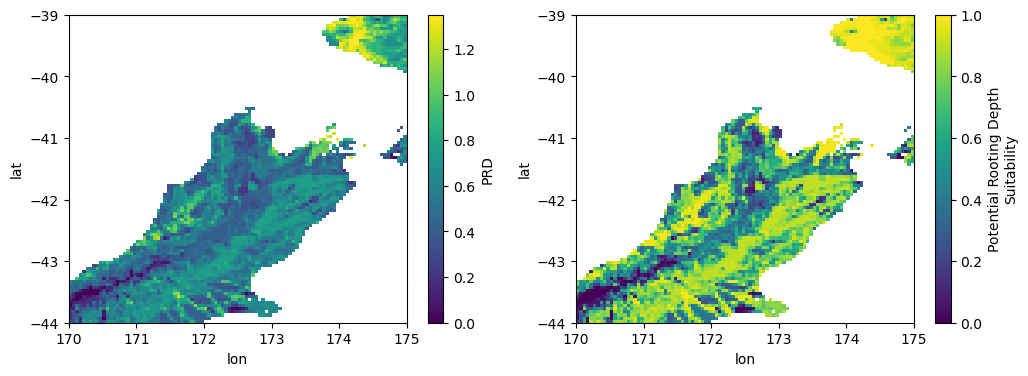
We can now compute the suitability of the criteria and plot the result.
[6]:
import matplotlib.pyplot as plt

prd = sc.compute()

fig, ax = plt.subplots(1, 2, figsize=(12, 4))
soil_data["PRD"].plot(ax=ax[0])
prd.plot(ax=ax[1], vmin=0, vmax=1)
plt.show()
Let’s see another example with climate data. We use xclim package to calculate the total annual precipition and use this latter as criteria indicator.
[7]:
from xclim.indicators.atmos import precip_accumulation

from lsapy.utils import load_climate_data

clim_data = load_climate_data()

pr_tot = precip_accumulation(clim_data["pr"], freq="YS")  # YS: Year Start frequency

sc = SuitabilityCriteria(
    name="water_requirements",
    long_name="Annual Rainfall Requirement Suitability",
    indicator=pr_tot,
    func=SuitabilityFunction(name="vetharaniam2022_eq5", params={"a": 0.876, "b": 1248}),
)
[8]:
water_req = sc.compute()

fig, ax = plt.subplots(1, 2, figsize=(12, 4))
pr_tot.isel(time=0).plot(ax=ax[0])  # use first year of data as example
water_req.isel(time=0).plot(ax=ax[1], vmin=0, vmax=1)
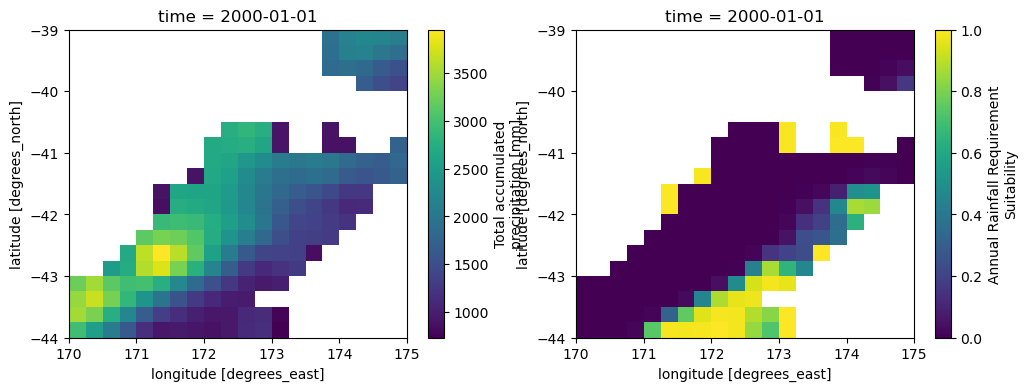
plt.show()